
Will Wales Make Cat Microchipping Mandatory After the CatsMatter Petition Progress?
Thousands of cats in Wales go missing, are injured, or are found dead each year with no reliable way to trace their families. For many rescuers, vets, and cat owners, the solution is simple and already familiar: microchipping.
The CatsMatter Campaign has taken that issue to the Senedd through a petition calling for the mandatory microchipping of cats in Wales. The petition, titled Introduce the Mandatory Microchipping of Cats in Wales, asks the Welsh Government to make cat microchipping a legal requirement, bringing Wales closer to the rules already in place for dogs and now for cats in England.
The campaign has now reached an important stage. The Senedd Petitions Committee has confirmed that the petition will be formally discussed at its meeting on Thursday, 8 October 2026. For us, this is a meaningful step forward. It gives the issue a public platform and asks elected representatives to consider whether Wales should move from encouragement to legislation.

Why the CatsMatter petition matters
The CatsMatter Campaign is a grassroots animal welfare campaign focused on improving outcomes for cats and the people who care about them. Our Senedd petition centres on one practical ask: make microchipping compulsory for cats in Wales.
At the moment, many responsible cat owners already microchip their pets. Vets, charities, and rescue groups have long encouraged it. But without a legal requirement, a large number of cats remain unchipped.
Estimates show that 25% to 30% of cats in Wales are not microchipped, which could mean around 180,000 unchipped cats. Welsh rescue groups also report that more than half of stray or lost cats coming into their care arrive without a microchip.
That creates a serious welfare problem. When a cat has no chip, rescuers may have no way to contact an owner. If the cat is injured, decisions become harder. If the cat has been killed on the road, families may never find out what happened.
A microchip does not stop a cat going missing. It does something different. It creates a permanent link between the cat and the person responsible for them.
That link can make the difference between:
a lost cat being reunited with their family
a stray cat being wrongly assumed to have no home
a road casualty victim remaining unidentified
a rescue centre holding an animal for longer than needed
an owner never having closure
For us, this campaign is not only about administration. It is about giving cats the same basic traceability that dogs already have.
What the petition is asking the Welsh Government to do
The petition asks the Welsh Government to introduce a legal requirement for cat owners in Wales to have their cats microchipped.
That would broadly mirror the approach already taken elsewhere. Dogs have been required to be microchipped for years across the UK. In England, compulsory cat microchipping came into force in June 2024, meaning cats must be microchipped by a set age, with keeper details kept up to date.
CatsMatter wants Wales to introduce similar rules, so cats are not left behind in animal welfare law.
Our argument is straightforward. Cats are one of the most common companion animals in Wales. They roam more freely than many other owned animals, which means they can become lost, injured, trapped, displaced, or involved in road collisions without their owners knowing. A microchip provides a simple way to identify them.
The petition does not suggest microchipping as a replacement for good care. It supports responsible ownership. A microchip works best alongside:
keeping contact details current
neutering where appropriate
using a quick-release collar if a collar is worn
reporting missing cats promptly
checking sheds, garages, and outbuildings for trapped cats
scanning found cats before assuming they are stray
The proposed law would make one part of that responsibility clear and consistent.
What happens next at the Senedd
The next key date is Thursday, 8 October 2026, when the Senedd Petitions Committee is due to discuss our petition.
A committee discussion does not automatically create a new law. It is part of the democratic process. The committee can consider the petition, discuss the evidence, and decide what further steps may be appropriate. That might include asking for more information, writing to the Welsh Government, seeking clarification from ministers, or closing the petition if members feel the matter has been sufficiently addressed.
Even so, getting to this stage matters. Petitions allow public concerns to be placed directly in front of Senedd Members. They also help show the level of public interest in a topic.
Supporters can follow the discussion through Senedd TV, which broadcasts Senedd proceedings and committee meetings. Watching the meeting can help campaigners understand what questions are being asked and what concerns still need answering.
The petition can be viewed on the Senedd petitions website here: Introduce the Mandatory Microchipping of Cats in Wales.
Why unchipped cats are so difficult to reunite
When a dog is found roaming, most people know there may be a legal owner and that the dog should be scanned. Cats are treated differently in everyday life. Because cats roam, people often assume a cat outdoors is simply exploring. That can make missing cat cases more complicated.
A friendly cat visiting gardens may be fed by several households. An elderly cat may look thin and be mistaken for stray. An injured cat may be taken to a vet, but without a chip nobody can easily confirm who they belong to.
Rescue groups often face these same problems. If an unchipped cat arrives at a rescue centre, staff may need to search missing pet posts, speak to local residents, check reports, and wait to see if anyone comes forward. That takes time and resources. It also puts pressure on already stretched animal welfare organisations and takes their time away from genuine cases.
For road traffic casualties, the issue is even more painful. If a cat has a registered microchip and is scanned, there is a better chance that the owner can be contacted. Without a chip, there may be no answer at all.
A microchip is small, but the information linked to it can carry a cat home.
The chip itself is only part of the system. The registered details must be correct. If an owner moves house, changes phone number, or transfers ownership, the database record needs updating. A compulsory system would need to make that clear so the law improves reunification in practice, not only on paper.
How Wales compares with England and dog microchipping rules
The campaign’s call is partly about consistency.
Dog microchipping has been compulsory for years, and many people now see it as a normal part of responsible dog ownership. The law recognises that dogs can go missing, be stolen, or become involved in incidents where identification matters.
Cats face many of the same risks. In some ways, they are even more likely to be found without an owner nearby because they are often allowed to roam independently.
England introduced mandatory cat microchipping in June 2024. That change placed a clear legal duty on keepers and gave vets, charities, councils, and welfare groups a firmer basis for encouraging compliance.
Wales has already recognised microchipping as part of wider animal welfare thinking. The Welsh Government’s Animal Welfare Plan for Wales 2021–2026 included reference to microchipping thanks to our previous petition, but mandatory legislation for cats has not yet been introduced.
That is the gap CatsMatter wants to close.
The campaign is not asking for an unusual or untested idea. It is asking Wales to adopt a rule that aligns with existing dog laws and with the direction already taken in England.
What supporters can do now
Anyone who supports the campaign can take simple, constructive steps before and after the committee discussion.
The most direct action is to read and share the petition page: Introduce the Mandatory Microchipping of Cats in Wales. Sharing the official link helps people see the exact wording and follow progress through the Senedd system.
Supporters can also watch the Petitions Committee discussion on Senedd TV on Thursday, 8 October 2026. If the meeting is available to view afterwards, it may also help people who cannot watch live.
Another useful step is to contact a Member of the Senedd. People can find their representatives through the Senedd’s official member search: Find a Member of the Senedd.
A short message is often enough. It can explain:
why mandatory cat microchipping matters
how lost or stray cats affect local communities
why Wales should match England’s cat microchipping rules
why rescue groups need better ways to identify cats
why families deserve to know when their cat has been found
Messages are strongest when they are polite, personal, and specific. A person who has lost a cat, rescued an unchipped stray, or worked with animal welfare groups can explain the real impact in a way statistics alone cannot.
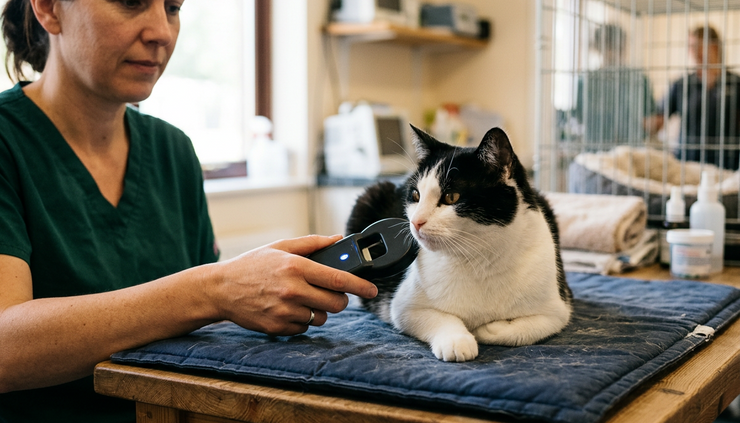
Cat owners can also act now by checking their own pets. A cat may already be microchipped, but the details may be out of date. Vets and many rescue organisations can scan a cat and confirm the chip number. Owners can then contact the relevant microchip database to check the registered information.
The practical case for making microchipping compulsory
Campaigns around animal welfare often involve complex questions. This one is practical. Microchipping is already common, widely available, and familiar to vets and animal charities.
The case for making it compulsory rests on four clear points.
It improves the chance of reunification.
A scanned chip can connect a found cat with a keeper quickly, as long as the database record is correct.
It supports rescue organisations.
When cats can be identified, rescue centres may spend less time trying to trace owners and may reduce unnecessary stays.
It helps with road casualty identification.
Families are more likely to receive news rather than being left not knowing.
It brings cats closer to equal protection with dogs.
If identification is accepted as a basic welfare measure for dogs, campaigners argue that cats deserve the same approach.
There will still be questions for lawmakers. Any new rules must consider enforcement, costs, exemptions, public awareness, and support for people who may struggle to pay. Those details matter. A fair system should encourage compliance without creating avoidable hardship yet England have already done the hard work for Wales to follow.
But those implementation questions do not remove the central welfare issue. Too many cats in Wales still have no reliable identification.

A small chip could make a major difference for Welsh cats
The CatsMatter petition has brought a long-running animal welfare concern to a clear decision point. On Thursday, 8 October 2026, the Senedd Petitions Committee will discuss whether Wales should move closer to compulsory cat microchipping.
The evidence presented by campaigners is hard to ignore. An estimated 25% to 30% of cats in Wales are unchipped. Rescue groups report that many lost and stray cats arrive without one. Families lose peace of mind, rescues lose time, and cats lose the best chance of being identified.
Wales now has the chance to consider a law that would match the direction already taken in England and reflect the protection long given to dogs.
For supporters, the next step is simple: follow the petition, watch the committee discussion, check your own cat’s chip details, and ask Senedd Members to back a practical change that could help thousands of cats find their way home.


Comments