
Sandy Survives Miraculous Cat Attack by Neighbor’s Uncontrolled Lurcher Greyhound Cross
Some cats leave pawprints all over a home. Sandy is one of them.
Victoria describes her as “the most affectionate fluff ball you could ever wish to meet.” Sandy is gentle, loving, and full of trust. She loves Victoria’s dog, Heidi, and trusts her implicitly. Because Heidi has always been safe and kind with her, Victoria believes Sandy may not have realised that not all dogs are like Heidi.
That trust made what happened on 7 April even more devastating.
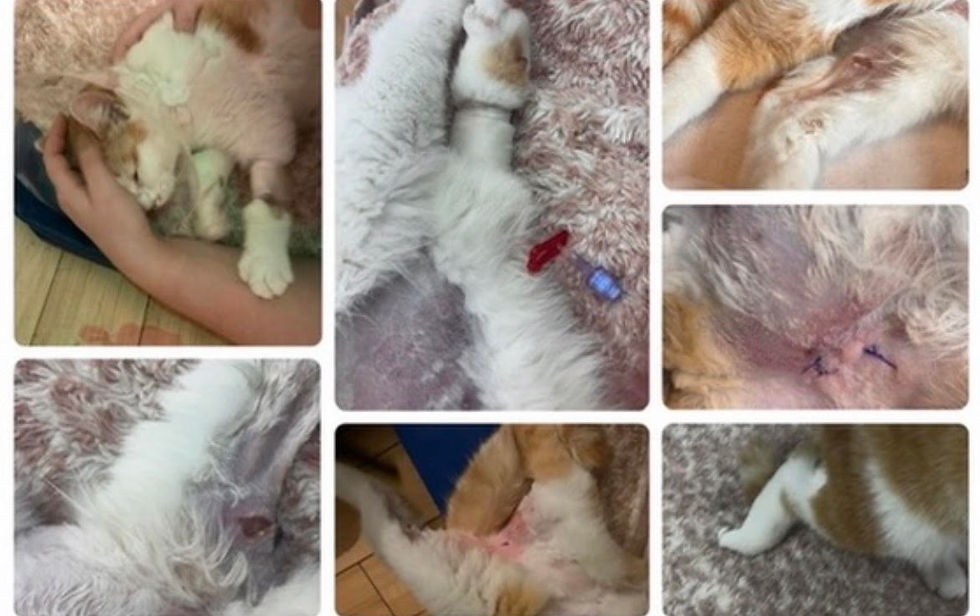
Sandy survived her attack by an absolute miracle. She was chased onto her driveway and into the bushes by a neighbour’s dog, described as a lurcher cross greyhound. There, according to Victoria and footage seen from neighbours’ CCTV and Ring doorbells, Sandy was savagely attacked.

Sandy was a loved family cat, not a threat
Sandy was not an unknown stray. She was not a nuisance animal. She was Victoria’s much-loved part of the family, and known for being affectionate.
At home, Sandy had a close bond with Heidi, Victoria’s dog. That relationship mattered. Sandy had grown up, or at least lived, with a dog she trusted. Heidi was safe to her. Heidi was predictable to her. Heidi was family.
Victoria believes Sandy “wasn’t sure all dogs weren’t like Heidi.” That small sentence says a lot about the danger domestic cats face when dog owners fail to control dogs with a strong prey drive.
Cats do not understand breeds, rescue histories, lead control, harnesses, muzzles, or recall training. They do not know which dogs are safe and which are not. A cat trying to get home may only have seconds to react when a powerful, fast dog starts to chase.
On 7 April, Sandy did not get those seconds.
The attack on 7 April
According to Victoria, the dog was allowed to get off lead. Once loose, it chased Sandy onto Victoria’s driveway and into the bushes.
The attack happened at the side of Victoria’s house. Neighbours’ homes face that side of the property, and the incident was caught on CCTV and Ring doorbells. That footage later became crucial, because it showed Sandy trying to get back home while the dog chased her.
Victoria says the dog’s owner did battle with the dog to get it off Sandy. That part matters, because it shows the dog was not under control and that the situation was serious.
But what happened next is hard to accept.
The owner then casually walked away from the scene and left Sandy fighting for her life alone. They did not inform Victoria that her cat had been attacked.
For any cat owner, that detail is almost impossible to process. When an animal has been badly injured, every minute matters. A frightened, injured cat may drag themselves away and hide. They may go silent. They may be in shock. Without urgent help, they can die unseen, even metres from home.
Sandy was left alone.
Victoria’s teenage son witnessed the horror
Victoria was not at home when the attack happened. She had popped herself and her daughter to the doctors.
Luckily, although terribly traumatic to hear and witness, Victoria’s teenage son noticed the attack from his bedroom window at the rear of the house. He saw enough to know something awful had happened and phoned his mum.
Victoria came home immediately.
The family began searching for Sandy, but they could not find her anywhere. Anyone who has ever searched for an injured cat will know that awful mix of panic and helplessness. You call their name. You check under cars, in bushes, behind bins, under sheds, along fences. You listen for the smallest sound.
Victoria’s nice neighbours helped search for Sandy. That kindness mattered. They stepped in when help was desperately needed.
Victoria says the owners of the dog still did not come out or offer to help look.
When she approached their door, Victoria says they claimed her cat had attacked them.
But Victoria later saw the CCTV video. In her words, Sandy was “just trying to get back home” and was chased by their dog, which they had no control of.

Why this should never have happened
Victoria says the dog was known to dislike cats. She also says the dog had been rescued, and that the owner told her it hated cats when she was first introduced to the dog.
That knowledge carries responsibility.
A lurcher cross greyhound can be a loving companion, but many dogs with sighthound heritage have a strong prey drive. These dogs were historically bred for speed, sight-based chasing, and hunting small animals. That does not make every individual dog dangerous, and it does not mean such dogs cannot live safely and happily with responsible owners.
It does mean owners must be realistic.
A prey-driven chasing dog can move at a speed that leaves a cat with almost no chance of escape. If that dog targets a cat, the cat may not be able to outrun it, outclimb it, or outmanoeuvre it in time. Where a cat sees a route home, a dog may see movement to chase.
Victoria believes the dog’s owners should have responsibly researched the breed. She says they should have known that a lurcher cross greyhound is a prey driven chasing dog that hunts and chases small animals, and that they can run at such speed that a cat can stand no chance of escape.
She also says the dog was never muzzled and did not have a harness on. A harness may have given the owner more control when the dog ran off. A muzzle, properly introduced and correctly fitted, can be a vital safety tool for some dogs, especially where there is known risk around cats or other small animals.
This is not about blaming a breed. It is about responsible ownership.
If a dog is known to hate cats, the owner must take that seriously every time the front door opens, every time a lead is clipped on, every time the dog is walked, and every time the dog is near homes where cats live.
The importance of CCTV and neighbour witnesses
Without the CCTV and doorbell footage, Sandy’s story could have been dismissed or twisted.
Victoria says the footage showed the dog chasing Sandy and showed Sandy trying to get back home. That matters because after the attack, when Victoria approached the dog’s owners, she says they claimed Sandy had attacked them.
Video evidence helped show what really happened.
For cat owners, this is a painful reminder that evidence can make a difference after an incident. It can help establish:
where the cat was before the attack
whether the dog was on or off lead
whether the dog was under control
what the owners did afterwards
whether anyone tried to notify the cat’s family
which neighbours may have witnessed the incident
CatsMatter always encourages people to gather facts calmly after any serious attack. Save footage quickly, because some CCTV systems overwrite old recordings. Ask neighbours if their cameras captured anything. Write down timings while they are fresh. Take photographs of the area, injuries, and any damage.
This is not legal advice, but practical record-keeping can help if the incident is reported to the relevant authorities, an insurer, a landlord, a council dog warden, or the police where appropriate.
Sandy’s survival was a miracle
Sandy survived.
That sentence is small, but in this case it is huge.
Victoria describes Sandy’s survival as “an absolute miracle,” and given the account of the attack, it is easy to understand why. A cat attacked by a fast, powerful dog can suffer devastating injuries. Even when a cat gets away, shock and hidden trauma can be life-threatening.
Sandy’s family had to cope with the horror of the attack, the panic of searching, and the trauma of knowing she had been left alone after being badly hurt.
The emotional impact of this kind of incident is often overlooked. People sometimes say, “It’s just a cat.” But Sandy is not “just” anything. She is a family member. She is loved. She trusts her home, her people, and her dog Heidi.
When a cat is attacked in or near their own home, the whole family suffers. The person who witnesses it suffers. The parent rushing home suffers. The neighbours who help search suffer. The surviving animal may suffer physically and emotionally.
And all of it may have been prevented with better control.
What responsible dog ownership looks like around cats
This story is not written to demonise dogs. CatsMatter knows many cats and dogs live safely together. Sandy herself loves Heidi. The issue is not dogs as a whole. The issue is uncontrolled dogs, known risk, and the failure to act responsibly.
When a dog has a high prey drive or a known dislike of cats, responsible ownership should include clear safeguards.
Use secure equipment
A strong lead, a well-fitted harness, and, where needed, a properly fitted muzzle can protect other animals and the dog. A muzzle is not a punishment when introduced kindly. It can prevent tragedy.
Do not rely on recall alone
A dog may come back perfectly in a quiet field, then ignore every command when a cat runs. Prey drive can override training in seconds.
Be honest about the dog’s history
If a rescued dog is known to hate cats or chase small animals, that risk must be treated as real. Hope is not a safety plan.
Avoid situations where the dog can slip free
Doorways, driveways, front gardens, loose collars, extendable leads, and poor harness fit can all lead to loss of control.
Take responsibility if the worst happens
If a dog attacks a cat, the owner should not walk away. They should alert the cat’s owner immediately, help locate the animal, provide their details, and cooperate fully.
Leaving an injured animal hidden and alone is cruel, whether through panic, shame, or indifference.
What cat owners can do after a dog attack
No cat owner should be expected to prevent every danger caused by an uncontrolled dog. The responsibility sits with the dog owner to control their animal. Still, after an incident, there are practical steps that may help.
If a cat has been attacked or chased and cannot be found:
Search quietly and close to home
Injured cats often hide nearby. Check under bushes, decking, sheds, cars, bins, and garden furniture.
Ask neighbours to check enclosed spaces
A frightened cat may get into a garage, outbuilding, greenhouse, or side passage.
Request CCTV footage quickly
Doorbell and security cameras may show where the cat ran.
Contact local vets
Give a description and microchip details. Ask them to note that the cat may be injured.
Leave familiar scent outside
Bedding or a blanket may help a frightened cat orientate, although food should be used carefully if it attracts other animals.
Document everything
Keep a written timeline, save messages, keep vet records, and photograph injuries if it is safe and not distressing for the cat.
If the cat is found, urgent veterinary care is essential, even if injuries do not look severe. Puncture wounds can be hidden under fur, and shock may not be obvious at first.
Sandy’s story matters
Sandy’s attack was not a minor neighbourhood dispute. It was a serious incident involving a loved cat, a dog that Victoria says was known to dislike cats, and a failure to notify the cat’s family after the attack.
The fact that Sandy survived does not make it less serious. It makes it more urgent that people listen.
At CatsMatter, we believe cats deserve to be safe in their own neighbourhoods. We also believe that dog owners deserve honest conversations about breed traits, prey drive, equipment, and responsibility. Pretending a chasing dog is harmless does not protect anyone. It puts cats, wildlife, the dog, and the wider community at risk.
Sandy was simply trying to get home.
She should never have been chased onto her own driveway. She should never have been attacked in the bushes beside her home. She should never have been left fighting for her life alone.

Sandy’s survival was a miracle, but safety should not depend on miracles.
It should depend on people doing the responsible thing before harm is done.


Comments